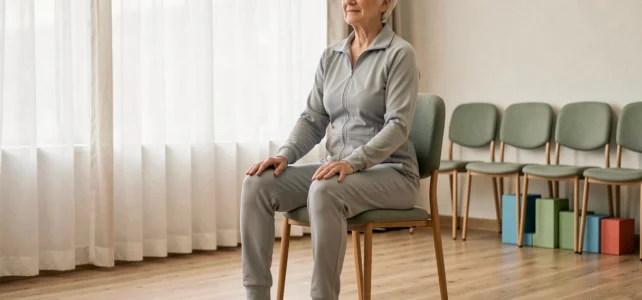
After 80 years, muscle mass loss accelerates and balance weakens. Gentle exercise is one of the most suitable responses to slow this decline, provided that movements compatible with the constraints of advanced age are chosen. This article details ten targeted exercises, their biomechanical logic, and the concrete precautions to ensure that practice remains safe.
Chair Exercises: The Foundation When Standing is Fatiguing
For individuals aged 80 and over, sitting securely ensures the session by eliminating the risk of imbalance. Recent programs focused on older adults prioritize this format before any standing progression.
You may also like : How to Get 10,000 Instagram Followers for Free and Boost Your Account Quickly
The first movement to master is the ankle flexion-extension while seated. Sitting on a stable chair (without wheels), feet flat, push on your toes to lift your heels, hold for two seconds, then lower. This action activates the calf muscles, which are engaged with every step to stabilize walking.
The second exercise targets the knees: extend one leg in front of you until it is horizontal, hold for a few seconds, then slowly lower it. Alternate. This movement strengthens the quadriceps, a muscle directly linked to the ability to rise from a chair or climb a step without assistance.
You may also like : Commitment to Equality and Women's Empowerment Worldwide
The third movement works the upper body. With arms at your sides, raise both arms laterally to shoulder height, palms facing down, then lower them. Without weights, the resistance remains low, which is suitable for arthritic shoulders. You can find other gentle exercise for 80-year-olds on Seniors des Infos that detail complementary seated variations.
Standing Strengthening with Wall Support: Working Strength Without Fall Risk
The wall replaces the training partner. It provides stable support and allows for strengthening exercises that the chair alone does not cover.
Wall push-ups engage the chest and triceps without excessive joint load. Stand facing the wall, hands at shoulder height, feet stepped back. Bend your elbows to bring your chest closer to the wall, then push back. The distance between your feet and the wall determines the intensity: the further back you go, the greater the effort.
Another wall exercise involves pressing your back against the wall, feet slightly forward, and sliding down into a half-knee bend (without going below a comfortable angle). This “wall half-squat” strengthens the thighs and glutes while protecting the lower back.
The sixth movement is the lateral leg raise. Standing facing the wall, with both hands resting on it, lift one leg to the side, knee straight, then bring it back. This action targets the hip abductors, muscles that stabilize the pelvis with each step and reduce lateral swaying often responsible for falls.
Balance Exercises Suitable for Seniors Aged 80
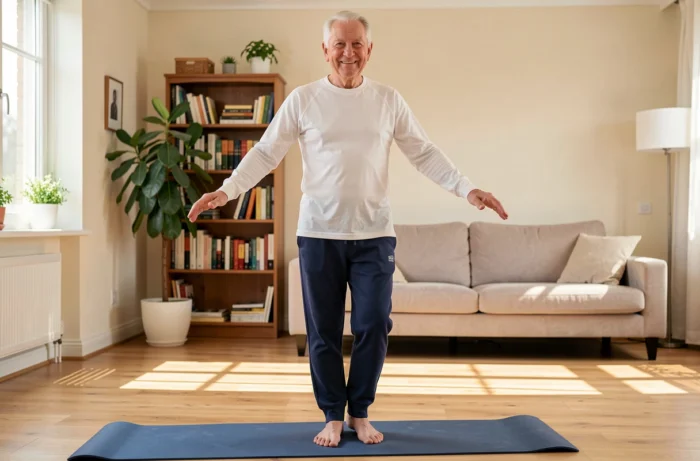
Balance gradually decreases with age, and the consequences of a fall after 80 can significantly compromise autonomy. Working on balance specifically has a measurable effect on fall prevention.
The seventh exercise is weight transfer. Standing behind a chair, hands on the backrest, slowly shift your weight from one foot to the other without lifting your feet off the ground. This controlled swaying stimulates the proprioceptive receptors in the ankle and foot.
The eighth movement maintains the same position, but this time you lift one foot off the ground (a few centimeters is enough) and hold the position for as long as possible. Balancing on one foot, even briefly, activates the stabilization muscle chains much more intensely than normal walking.
The ninth exercise is heel-to-toe walking. Place one foot in front of the other, with the heel just in front of the toes of the back foot, as if on an imaginary line. Walk a few meters down a hallway, keeping a wall or handrail within reach. This movement works on coordination and proprioception in a pattern close to actual walking.
Breathing and Cool Down: An Often Overlooked Exercise After 80
The tenth exercise concludes the session, but it is not just a simple “relaxation bonus.” Diaphragmatic breathing improves muscle oxygenation and reduces blood pressure post-exercise.
Sit comfortably, placing one hand on your belly. Inhale through your nose while expanding your belly (not your chest), then exhale slowly through your mouth, mentally counting to six. Repeat five to ten times. This cool down also helps reduce heart rate after standing exercises.
Structuring a Gentle Exercise Session After 80: Duration and Frequency
Recent content converges towards short sessions structured into three blocks: joint warm-up, main work, cool down. A format of fifteen minutes regularly appears as an appropriate duration for older adults, sufficient to produce a physiological effect without causing excessive fatigue.
A realistic breakdown to incorporate the ten exercises:
- Warm-up block (ankles, arm raises on chair): about three to four minutes, slow and progressive movements
- Strength and balance block (wall push-ups, wall half-squat, leg raises, weight transfers, single-leg support, heel-to-toe walking): eight to ten minutes, alternating upper and lower body
- Cool down block (diaphragmatic breathing): two to three minutes, seated
Three sessions per week is often recommended to observe progress in balance and strength. The available data does not allow for a conclusion on a universal minimal threshold, as capacities vary from person to person at this age.
Environmental Safety: A Parameter as Determinant as Exercise Choice
The quality of the practice location directly conditions safety. Some recent content emphasizes this often-overlooked point: practicing alone in front of a screen without any support exposes individuals to risks that the exercise itself does not create.
- Chair without wheels, placed on a non-slip surface (no sliding mats, no waxed floors)
- Clear space around the practitioner: at least one meter free on each side for arm and leg movements
- Sufficient lighting to perceive obstacles on the ground (cables, door thresholds, edges of mats)
- Accessible phone in case of discomfort, especially for those living alone
For very tired or recovering seniors, some exercises can be performed from bed or in a semi-reclined position, particularly ankle flexions and diaphragmatic breathing. This adaptation allows for maintaining a minimum level of activity even on difficult days.
Gentle exercise after 80 is not aimed at performance. It aims to maintain daily movements: getting up, walking, reaching for an object above, keeping balance on uneven ground. The ten exercises described here cover these functions. The most determining factor remains regularity, even with very short sessions.