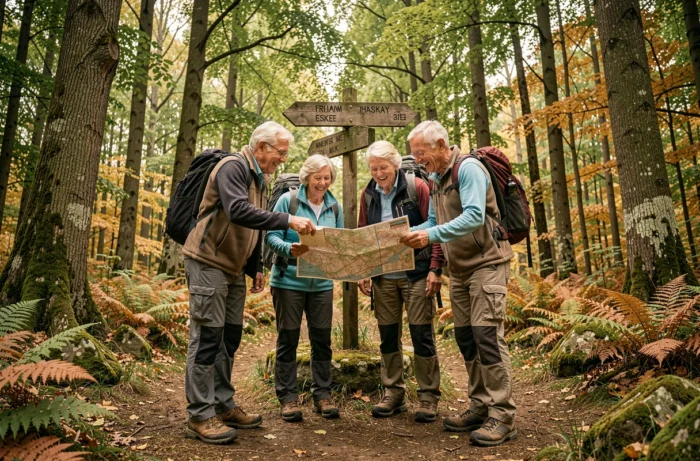
Walking alone on a trail is pleasant. Walking with others who share the same pace and desire to chat is a whole different experience. Nature clubs for single seniors are multiplying in France, and their operation has changed in recent years: fewer large anonymous groups, more outings in small committees where exchanges happen naturally.
Why hiking in small groups changes the dynamics of senior meetings
Have you ever noticed that a conversation starts more easily when walking side by side than when sitting face to face? It’s not a coincidence. The walking position removes the pressure of constant eye contact. We look at the path, the landscape, and the words come without forcing.
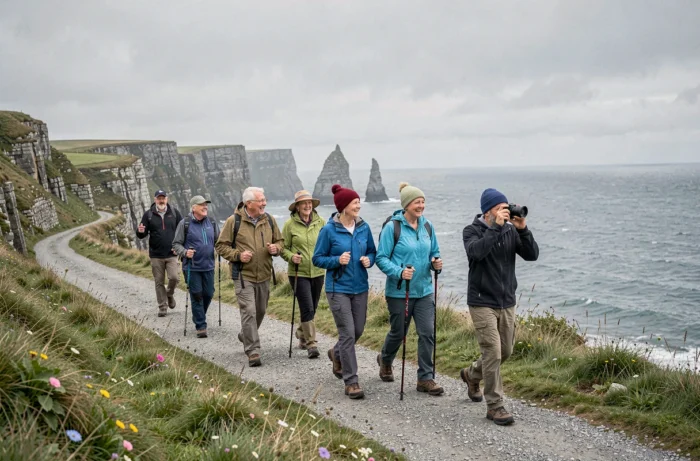
Hiking clubs for single seniors exploit this mechanism. By tightening the groups (often fewer than ten participants), they create an environment where everyone can talk to each other during the outing. A large group of thirty walkers, on the contrary, quickly fragments into fixed sub-groups from the first minutes.
The physical effort also plays a concrete role. On an uphill climb, regardless of professional background or social status: everyone is out of breath, everyone slows down. This equality through effort facilitates initial exchanges between people who, in another context, might never have spoken to each other. Several organizers, including those listed on the Green Seniors website for single seniors, structure their outings around this small group principle.
Slow trekking for single seniors: the rising format
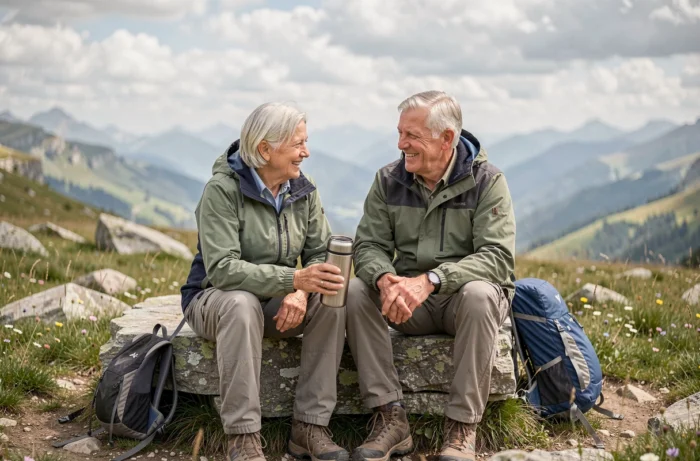
The term may be surprising, but slow trekking describes a simple reality: walking slower, for less time, with less elevation. The goal is not athletic performance. It’s the shared attention to the landscape, wildlife, and details of the trail.
This format particularly appeals to seniors who are resuming walking after a break or who have never been great athletes. The absence of pressure on the pace removes the apprehension of slowing down the group. And when no one is racing against the clock, breaks become real moments of conversation.
What distinguishes slow trekking from a classic walk
A group walk follows a route, period. Slow trekking adds an intention: to observe, name, and share what we see. Some clubs incorporate thematic stops (plant identification, bird watching) that provide a natural pretext for discussion.
Slow trekking transforms walking into a social activity without artifice. No forced introduction games, no awkward round-table discussions. The connection is created by what we look at together.
Safety in senior hiking: a selection criterion for the right club
The quality of a nature club for seniors is not only measured by its friendliness. It is also measured by the rigor with which it organizes safety. This point has become central in the recommendations published by hiking prevention sites in 2026.
Before signing up, check these concrete elements:
- Marked route communicated in advance: the club must send the itinerary to participants before the outing, including the elevation and estimated duration
- Instruction to share the itinerary with a friend who is not participating, so that an outsider knows where you are
- Verification that each participant has a charged phone and suitable equipment (shoes, water, sun protection)
- Presence of a guide trained in first aid, or at least an identified point of contact in case of a problem
A club that never mentions these aspects in its communication deserves caution. Safety is not a barrier to friendliness; it is what makes it possible. When we know we are supported, we relax, and it is precisely when we are relaxed that we become open to others.
Choosing a hiking club for singles based on your profile
Not all nature clubs offer the same thing. And that’s a good thing because not all single seniors have the same expectations. Some are looking for a weekly outing near their home. Others prefer a few days’ stay in a region they don’t know.
Local outings or hiking trips: two different logics
The local outing (half-day or full day) suits those who want to integrate hiking into their routine without disrupting their schedule. The same faces are seen from week to week, which allows for gradual bond-building.
The multi-day hiking trip works differently. Immersion creates accelerated closeness: we share meals, evenings, sometimes vehicle transfers. Conversations go deeper, faster. However, the bond can remain ephemeral if no one takes the initiative to keep in touch after returning.
Practical criteria to filter serious clubs
- Does the club specify the age range and expected walking level? A mixed group of 30-70 years does not offer the same dynamic as a group of 55+
- Are the outings supervised by an identified leader or simply self-organized via a Facebook group?
- Is there visible history (photos of past outings, testimonials, regular calendar) or is it a page created last week?
A club that publishes a regular calendar with detailed routes inspires more confidence than a page that promises meetings without ever showing a completed outing.
Autumn and outdoor meetings: the ideal season to start
September and October bring particularly favorable conditions to start group hiking. The temperatures are mild, the trails less crowded than in summer, and the autumn light makes the landscapes more photogenic. Clubs are relaunching their programs after the summer break, which means new participants are arriving at the same time.
Joining a group at the beginning of the season avoids the discomfort of arriving in an already established circle. Everyone is discovering each other; no one is “the new one.” It’s a logistical detail, but it changes the experience of the first day.
Hiking for single seniors does not need to be sold as an extraordinary adventure. It is an accessible physical activity, practiced in a setting that encourages sincere exchanges. The right club is the one that matches your walking pace and social expectations, not the one that promises the most meetings on its homepage.