A weeded bed in late April, and three weeks later the bindweed is already back among the tomato plants. We all know this scenario. Stopping the proliferation of weeds in the garden does not rely on a single miracle method, but on a combination of actions that target the problem at its source: light, bare soil, and dormant seeds in the ground.
Legal framework for weeding: what individuals are no longer allowed to use
Before discussing techniques, let’s clarify a point that many gardeners still ignore. Since January 1, 2019, the Labbé law prohibits individuals from purchasing, using, and possessing most synthetic phytopharmaceutical products, including glyphosate-based herbicides.
A decree from January 15, 2021, reinforced this ban: since July 1, 2022, traditional chemical herbicides are banned in private gardens. Only three categories remain authorized: biocontrol products, low-risk products, and those usable in organic farming marked with the mention “Authorized for use in gardens” (EAJ).
In practical terms, the strategy of applying total herbicide once a year on pathways no longer exists legally. Any effective approach now relies on mechanical, thermal, or preventive methods. We detail below those that work as documented on the Les Défricheurs website, with a practical angle suited to the terrain.
False sowing before planting: eliminating weeds before they become a problem
False sowing is the most underestimated technique for reducing weed pressure, especially in the vegetable garden. The principle is simple: prepare the soil as if you were going to sow (loosen, water), then wait for the weed seeds to germinate. Once the seedlings have emerged, destroy them with a hoe or rake, without turning the soil deeply.
One false sowing significantly reduces the seed stock on the surface. You can do it two to three weeks before planting for an even clearer result. The key: do not turn the soil after the last pass, otherwise, you will bring up new seeds buried deeper.
This method requires patience, with a delay of two to four weeks before sowing or planting. In the vegetable garden, it is often scheduled between March and May depending on the region. For a plot left fallow in winter, it is the best time investment you can make.
Covering the soil: mulching, cardboard, and ground cover plants against weeds
Bare soil is the enemy. Every inch of exposed soil to light is an invitation for weed seeds. Covering the soil remains the most effective preventive method over time.
Organic mulching in the garden: appropriate thickness and materials
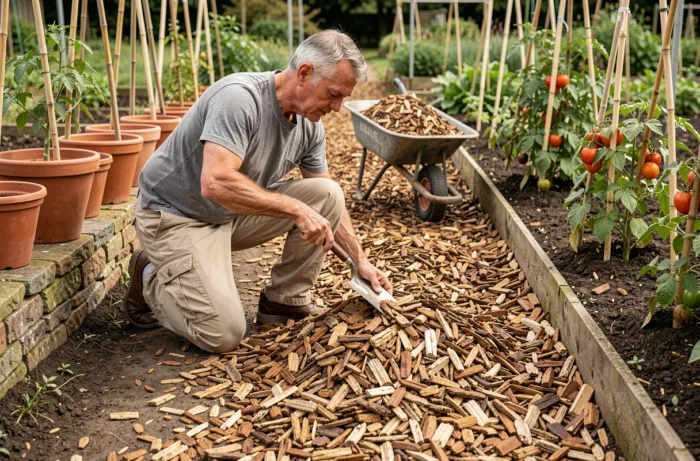
We often talk about mulching, but a two-centimeter layer of grass clippings is not enough. To effectively block light, a thickness of at least five to eight centimeters of material is required, renewed as it decomposes. The choice of material depends on its use:
- Wood chips or branch chippings (BRF) are suitable for shrub beds and tree bases, where they decompose slowly without hindering crops
- Straw or hay are suitable for the vegetable garden between rows of vegetables but can sometimes attract slugs in damp areas
- Shredded dead leaves work well in autumn to protect the soil during winter and limit the spring emergence of weeds
The classic trap: mulching on already infested soil. Mulching does not kill established perennials like couch grass or bindweed. We weed first, then we mulch.
Cardboard and tarps: occlusion for plots in preparation
For a plot that is not immediately cultivated, placing raw cardboard (without ink, without tape) directly on the vegetation works remarkably well. In a few months, the weeds suffocate due to lack of light, and the cardboard decomposes in the soil.
Occultation tarps (woven fabric or opaque tarps) serve the same purpose on heavily infested grounds. They are left in place for several months before planting. Feedback varies on this point depending on the type of soil and the species present, but on clayey ground infested with dock, you should expect at least a full season.
Ground cover plants to prevent weeds from establishing
In perennial beds, ground cover plants take over from mulching by occupying space close to the ground. Dwarf white clover works well at the base of fruit trees. Sedums colonize dry and stony areas. Phacelia or mustard, sown as green manure between two crops in the vegetable garden, occupy the ground and prevent weeds from germinating.
Mechanical and thermal weeding: when and how to intervene on the roots
Despite all preventive precautions, some weeds get through. Weeding then remains necessary, but the method and timing make all the difference.
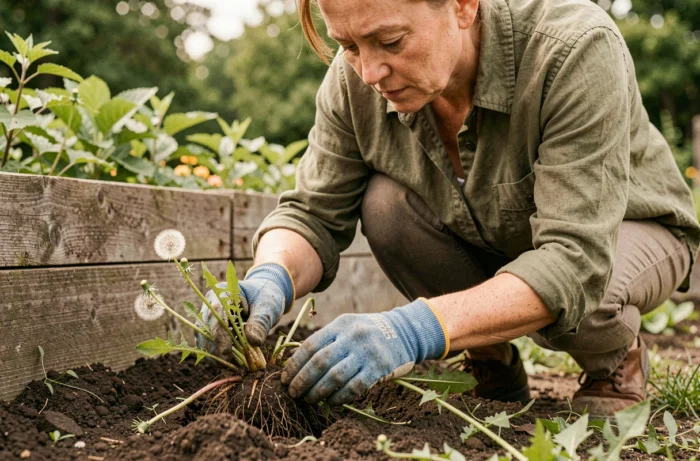
Pulling weeds before they flower prevents seed production and reduces pressure the following year. For perennials with rhizomes (couch grass, bindweed, horsetail), it is essential to extract as many roots as possible. The right tool makes a difference:
- The weeding gouge or knife allows you to extract taproots (dandelion, dock) without turning all the surrounding soil
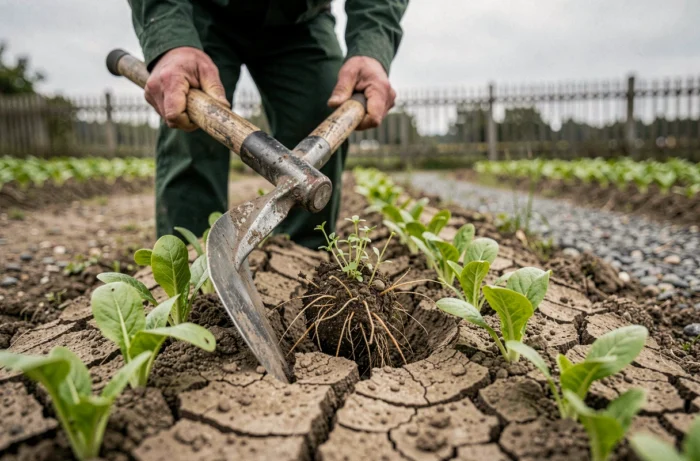
- The oscillating hoe cuts seedlings just below the surface, ideal for regular passes between rows in the vegetable garden
- The thermal weeder (flame or steam) destroys aerial parts by thermal shock, effective on gravel paths and terraces
Thermal weeding does not destroy deep roots. For grasses or clover in pathways, you need to repeat passes to exhaust the plant. However, for young seedlings, a single pass is sufficient.
The best time to weed manually remains after rain when the soil is loose. You extract many more roots than in dry soil, where they break and regrow.
Combining false sowing, permanent soil coverage, and targeted mechanical interventions requires more planning than an old chemical treatment. The result, over two or three seasons, is a garden where weed pressure decreases significantly because we have depleted the seed stock instead of treating the symptoms.