The duck down filling from the Pyrenees, the historical craftsmanship in Saint-Sever, and Pyrenex’s premium positioning make it a logical target for counterfeiters. We have observed a rise in copies on marketplaces over several seasons, with an increasing level of finish that complicates quick visual identification. Here are the technical checkpoints that allow for differentiation.
Traceability of Pyrenex down: what the textile composition reveals
The filling is the first reliable indicator. Pyrenex uses grey duck down collected from the South-West of France, sourced from local agricultural channels. The brand adheres to a short supply chain logic and promotes the valorization of a by-product of farming, which it claims as upcycling.
On an authentic down jacket, the composition label precisely mentions the down/feather ratio. Counterfeits often display vague or inconsistent mentions, sometimes an unrealistic down percentage for the displayed price. A synthetic filling or a blend of polyester fibers immediately betrays the copy.
We recommend feeling the compartmentalization: on a Pyrenex model, the compartments are regular, and the down is evenly distributed without dead zones. A counterfeit shows clumps, irregular compartments, or a flat touch that indicates low-quality filling. To know if your Pyrenex is authentic, this tactile verification of the filling remains one of the most discriminating actions.
Logo, labels, and stitching: the details that betray a Pyrenex counterfeit
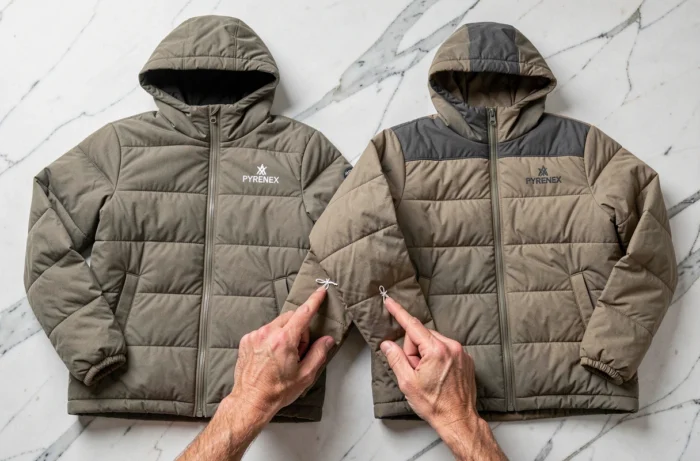
The Pyrenex logo embroidered on the chest or arm adheres to precise standards. On an authentic model, the embroidery is clear, the letters are evenly spaced, and the thread used does not bleed onto the surrounding fabric. Counterfeits frequently feature a logo with blurry contours or irregular spacing between characters.
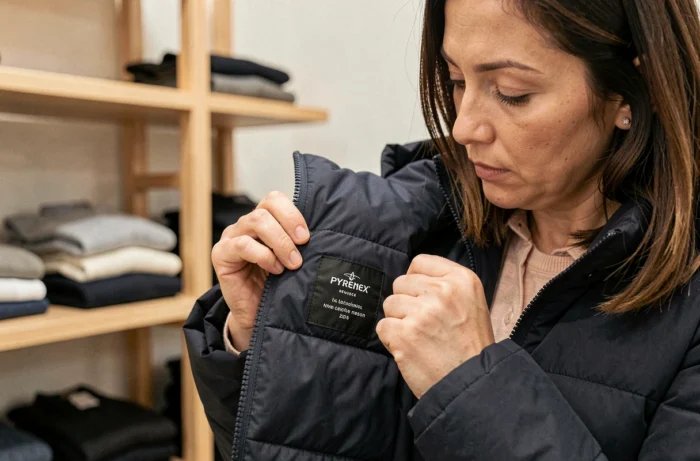
The inner label provides additional information. Check for the complete company name, the country of manufacture, and care instructions in correct French. Some Pyrenex products are assembled outside of France, which does not undermine authenticity, but the label must remain consistent with the brand’s standards.
The stitching deserves careful inspection:
- The topstitching is straight, regular, without any loose threads or skipped stitches. A double stitching in stress areas (shoulders, armholes) is common on authentic models.
- The zippers generally bear an identifiable hardware brand (like YKK or a premium equivalent). A lightweight pull tab, without markings, or one that catches during use indicates a low-quality component.
- The snap buttons and ventilation eyelets are securely attached, without metal burrs or excessive play. On a counterfeit, these metal pieces often have a dull appearance or a surface treatment that chips easily.
Buying a second-hand Pyrenex down jacket: the role of authentication platforms
The second-hand market today represents a major purchasing channel for Pyrenex down jackets, and consequently a fertile ground for counterfeits. The choice of platform and authentication option has become a security criterion in its own right.
Since 2023, platforms like Vinted have strengthened their verification procedures for certain branded items, with offline examinations conducted by specialized teams. These checks focus on stitching, logos, materials, and provenance documents. Authentication has become a central conversion argument in the online resale market in France.
The massification of the second-hand market mechanically increases the volume of fakes in circulation. We recommend systematically prioritizing listings that offer the “authenticated” option or asking the seller for the original proof of purchase, the receipt, or the online invoice. A seller who refuses to provide these elements is a red flag.
Pyrenex down jacket: reliable points of sale and traps to avoid
Purchasing from an official Pyrenex store, on the website pyrenex.com, or at an authorized retailer (including outlets) remains the strongest guarantee. Authorized distribution networks offer secure payment, traceable delivery, and return rights in accordance with French regulations.
Third-party sites with abnormally low prices are the main vector for online counterfeiting. Several indicators should raise alarms:
- A price that is half or more below the catalog price, without justification (end of collection, official outlet).
- A site without French legal mentions, without a SIRET number, or with payment exclusively via bank transfer or PayPal “friends and family”.
- Product photos copied from the official site but with approximate or automatically translated descriptions.
The INPI reminds us that in the face of counterfeiting, verifying the seller’s identity and the distribution channel protects as much as inspecting the product. The combination of both approaches, physical control of the down jacket and reliability of the point of sale, remains the safest method to secure a Pyrenex purchase, whether new or second-hand.