
An oyster farmer from the Gulf of Morbihan wanting to sell directly, a web developer based in Lannion looking for her first local clients, a construction artisan in Fougères hesitating to hire: the situations differ, but the initial constraint remains the same. Succeeding locally in Brittany requires understanding the concrete mechanisms of the territory, not just its advertised attractiveness.
Emerging sectors in Brittany: targeting areas where demand already exists
The agri-food and tourism sectors remain structural in the Breton economy, but they no longer summarize the landscape.
The region is now organizing ecosystems around identified sectors: cybersecurity, marine energies, renewable hydrogen, future agri-factory. Clusters, technopoles, and regional agencies structure access to skills, funding, and partners in each of these themes.
For those looking to develop their business in Brittany, the question is not about jumping into a trendy field. It is about checking if a local sector already has an organized network capable of generating orders, subcontracting, or collaborations.
Smart agriculture and biocontrol, for example, mobilize farms, laboratories, and sensor suppliers within a limited geographical area. Positioning oneself as a specialized service provider grants access to a structured local market.

Demographic aging in Brittany and local markets
Brittany combines demographic growth with an aging population. This dual movement creates concrete needs that content about regional attractiveness rarely mentions.
Small towns and villages concentrate a denser network of local shops than the national average. This Breton particularity is not a coincidence: it responds to an aging population that moves less and consumes locally.
In practice, we observe under-exploited markets in several areas:
- Personal services tailored to seniors in rural or semi-rural areas, where demand exceeds available supply
- Soft mobility and adapted transport for towns far from main roads
- Intermediate housing between home and specialized facilities, a segment where local project leaders have an advantage over large national groups
Starting a business in these niches requires a deep understanding of the local living area. Feedback varies by territory: a service that works in Pontivy may not necessarily find its clientele in Redon. Studying local demand, community by community, remains a prerequisite.
Technopoles and on-the-ground support in Brittany
Brittany has a network of technopoles that covers the entire territory. These structures are not limited to hosting startups. They offer operational support: connecting with clients, access to shared spaces, sector monitoring.
What aid programs actually fund
In practice, regional grants target material investment and job creation, rarely covering ongoing operations. An artisan wanting to buy a machine tool or a retailer renovating a shop in the town center is more likely to obtain funding than a consultant looking to cover prospecting costs.
Communities of municipalities also play a direct role. Pontivy Communauté, for example, has set up a financial boost to support local businesses. This type of local aid, often overlooked, deserves to be identified even before finalizing one’s establishment.
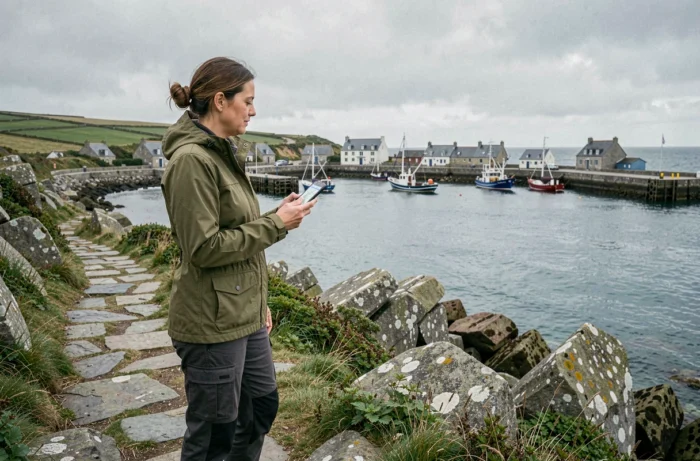
Local anchoring in Brittany: network and reputation before digital marketing
One can invest in a high-performing website and online advertising campaigns. But in Brittany, local recommendations remain the primary acquisition channel for small businesses. The dense associative fabric, business clubs by employment basin, and weekly markets create contact points that no digital strategy can replace.
A concrete example: a service provider who regularly attends meetings of a business club in their intercommunal area builds visibility that three months of local SEO will not provide. Prescribers (accountants, notaries, real estate agents) direct requests to professionals they know personally.
Combining physical presence and digital visibility
Digital visibility is not useless, but it comes second. An optimized Google Business listing with local customer reviews complements on-the-ground reputation. Directories of technopoles and regional platforms for innovative businesses also offer targeted exposure to potential partners.
- Registering one’s business in the directories of intercommunalities and local Chambers of Commerce
- Systematically collecting customer reviews after each service to enhance one’s online profile
- Participating in at least one local professional event per quarter to keep the network active
Brittany remains a territory where trust is built over time. An entrepreneur who sets up and disappears from the radar for six months will almost have to start from scratch. Regular local presence matters more than the intensity of occasional actions.
Establishing oneself sustainably in the Breton territory relies on choosing a sector where local demand is already organized, mobilizing the concrete aids available at the intercommunal level, and making a regular investment in the local network.