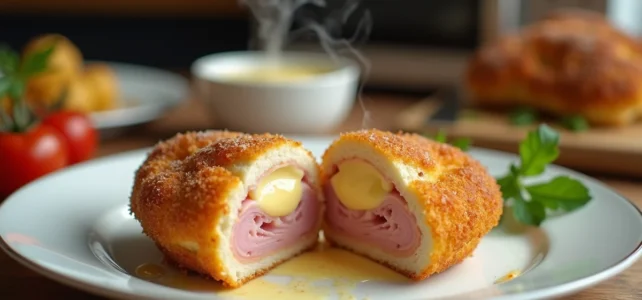
An industrial breaded cordon bleu contains a filling of raw poultry protected by a breadcrumb coating that acts as a thermal insulator. In the microwave, this structure poses a specific problem: the waves penetrate the coating, heat the water present in the meat, but create cold spots where the temperature remains insufficient to eliminate pathogens. We recommend reserving the microwave for reheating a cordon bleu that has already been cooked, not for cooking it from a raw state.
Thermal gradient and cold spots: why the microwave cooks breaded poultry poorly
The magnetron generates standing waves inside the cavity. The rotating plate partially compensates for the uneven distribution of the electromagnetic field, but it does not eliminate it. On a thick product like a cordon bleu, the temperature difference between the center and the edges can remain significant after several minutes of heating.
See also : Everything You Need to Know About the Van Dyke Beard: Definition, Tips, and Maintenance Advice
The coating exacerbates the phenomenon. Dry on the surface, it absorbs less energy than the moist center. The melted cheese in the center acts as a thermal sink that captures heat without redistributing it evenly to the surrounding meat. The result: the surface seems burning, the cheese flows, but the poultry in direct contact with the coating remains lukewarm.
Health authorities, particularly ANSES, advise against fully cooking raw chicken in the microwave for this reason. Only small pieces that are already cooked, reheated at reduced power while stirring often, present an acceptable level of safety. Cooking a product that requires checking that the cordon bleu in the microwave reaches a uniform temperature remains a delicate exercise without a probe thermometer.
You may also like : How to Choose the Best Battery for a 3000W Solar Panel: Guide and Tips
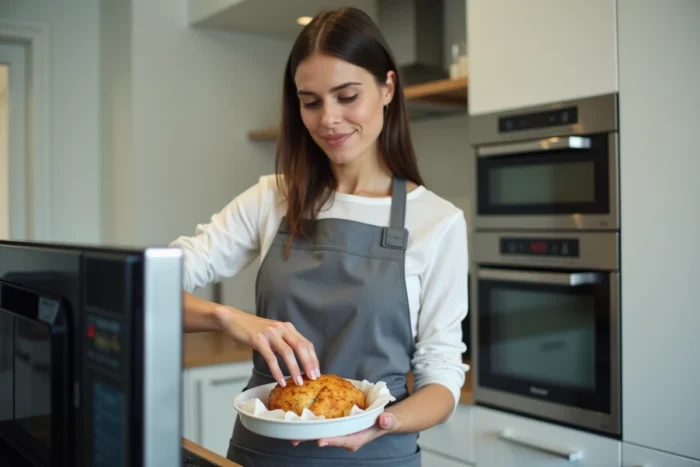
Reheating a pre-cooked cordon bleu in the microwave: protocol and power
The only situation where the microwave works correctly with a cordon bleu is reheating a product that has been previously cooked in a pan or oven. We observe that most failures come from too high a power and too short a time.
Choice of container and arrangement
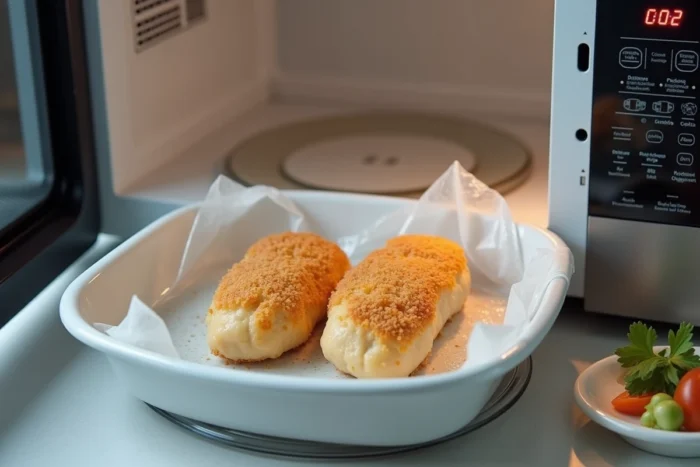
Transfer the cordon bleu to a microwave-safe glass or ceramic container. Original plastic trays and food packaging are not all designed to withstand rising temperatures. ANSES reminds that migrations of substances from certain plastic containers increase with heat.
Place the cordon bleu flat, without stacking. If you are reheating two, leave space between them for the waves to circulate. Cover the container with a compatible lid or an inverted plate, never with cling film not intended for this use.
Moderate power and resting time
- Set the microwave to medium power (about half of the maximum power). High power dries out the coating and hardens the cheese without improving the temperature in the center.
- Heat in short intervals, turning the cordon bleu halfway through. This action compensates for the cold spots on the plate.
- Let it rest for one to two minutes after the microwave stops, with the door closed. The residual heat continues to spread towards the center of the product and homogenizes the internal temperature.
This resting time is the most neglected point. Without it, you measure a misleading surface temperature while the center has not yet reached equilibrium.
Keeping it crispy: the physical limits of the microwave
The microwave heats by agitating water molecules. It does not produce Maillard reaction or caramelization, two phenomena that require dry heat above 150 °C on the surface. A cordon bleu reheated in the microwave will never be crispy.
The coating softens because the evaporated water from the meat remains trapped under the lid and condenses on the breadcrumbs. This is a physical phenomenon, not a technical flaw. No trick (absorbent paper, elevated rack) replicates the result of a convection oven or an oiled pan.
The two-step method remains the most effective: reheat the center in the microwave at moderate power, then briefly place the cordon bleu in a hot, lightly oiled pan. The pan recrisps the surface in just a few seconds. This is not a compromise; it is the only way to achieve a proper result.
Food safety: Listeria and refrigerated cordon bleus
Refrigerated industrial cordon bleus are ready-to-eat products that allow the growth of Listeria monocytogenes during their shelf life. European regulations are tightening their requirements: from July 1, 2026, the total absence of Listeria in 25 g at the use-by date will be required for these products, unless contrary scientific evidence is provided by the manufacturer.
This regulatory evolution directly concerns consumers who reheat these products without complete prior cooking. A poorly used microwave (too high power, too short time, lack of turning) leaves pockets at insufficient temperatures where bacteria survive.
- Always check the use-by date before reheating a refrigerated cordon bleu. A product close to the expiration date carries more risks.
- Never refreeze a thawed cordon bleu that has been reheated in the microwave. The thermal cycle promotes bacterial proliferation.
- If in doubt about the initial cooking of the product, prefer complete cooking in the oven or pan before any further reheating.
The microwave remains a reheating tool, not a cooking one, for breaded poultry products. Accepting this limit helps avoid taste disappointments and health risks. For a cordon bleu taken from the refrigerator without prior cooking, using a pan over medium heat for a few minutes on each side remains the most reliable method.