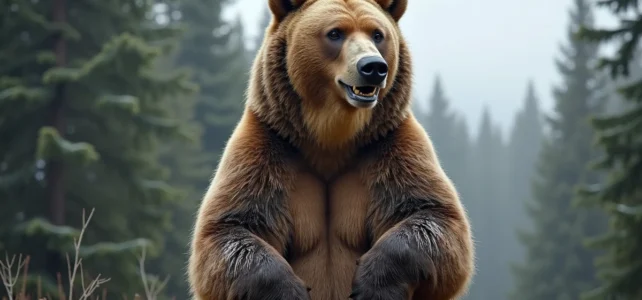
The grizzly (Ursus arctos horribilis) and the European brown bear (Ursus arctos arctos) belong to the same species. Taxonomy only separates them at the subspecies level, which makes the question of size more nuanced than a simple continent versus continent match. We observe marked morphological differences, but also overlaps that popularization often ignores.
Morphological Plasticity of Ursus arctos: Why Subspecies Alone Is Not Enough
Reasoning solely by subspecies leads to shortcuts. In Ursus arctos, adult size depends more on the availability of seasonal proteins and lipids than on genetic clade. An interior Rocky Mountain grizzly, deprived of anadromous salmon, remains significantly smaller than a coastal grizzly from Alaska.
Further reading : Tubidy Buzz: Downloading Music Online, Is It Really Legal?
The same mechanism applies in Eurasia. The Ussuri brown bear is among the largest brown bears in the world, with measurements approaching those of the Kodiak bear from Alaska. Populations in Kamchatka, in the Russian Far East, benefit from massive runs of salmonids, just like North American coastal bears.
In other words, opposing “grizzly” to “European brown bear” masks the true determinant: access to a fat-rich food resource. A Romanian brown bear from the Carpathians, partially fed on food waste, can exceed in mass a Wyoming grizzly living at altitude.
You may also like : Having an average of 13 in middle school: is it enough to succeed in school?
For a detailed comparison of grizzly and brown bear size, average measurements tell only part of the story.
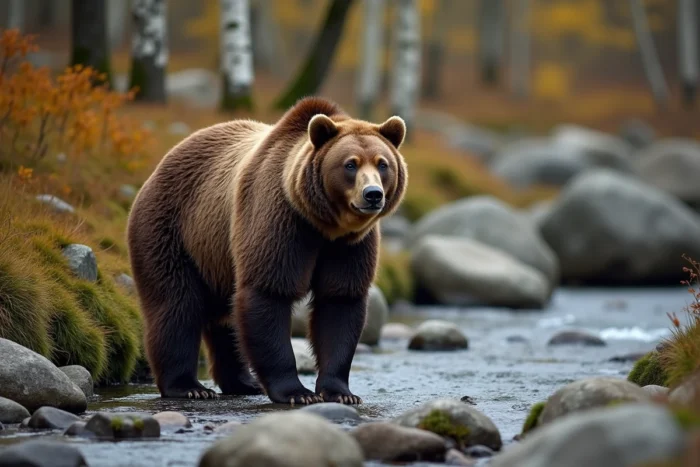
Average Size of the North American Grizzly Compared to the Western European Brown Bear
When we compare the most studied populations (interior grizzlies vs. Pyrenean or Scandinavian brown bears), the grizzly clearly comes out on top. Adult males from the North American interior reach significantly higher masses than brown bears from Scandinavia or the Pyrenees. Females follow the same pattern, with pronounced sexual dimorphism in both cases.
The Pyrenean brown bear is one of the smallest representatives of Ursus arctos. The Ferus association reminds us that the Pyrenean bear has nothing to do with the American grizzly, neither in size nor in behavior. Comparing the two is like comparing an Iberian wolf and a Yukon wolf: same species, radically different ecology.
Shoulder Height and Body Length
Shoulder height does not vary as much as mass. The grizzly is primarily distinguished by its muscular dorsal hump, made up of slow-twitch fibers inserted on the spinous processes of the thoracic vertebrae. This hump gives it a characteristic silhouette and a digging power absent in most European brown bears.
The total length (muzzle-to-tail) of the grizzly is on average greater than that of the Scandinavian brown bear, but remains comparable to that of large Romanian males. The Kodiak bear from Alaska remains the largest living brown bear, across all populations.
Eurasian Brown Bear: The Populations That Comparison Forgets
Most popular articles compare the grizzly to the “European” brown bear without specifying which population is being referred to. Europe is home to very heterogeneous populations:
- The Romanian Carpathian bears, among the densest in Europe, with males reaching masses well above those of Scandinavian bears due to an omnivorous diet enriched by human proximity.
- The bears of the Dinarides (Slovenia, Croatia), of intermediate size, living in mixed forests with a predominantly plant-based diet.
- The Pyrenean bears, a relic population of low numbers, whose average size remains the most modest on the continent.
Expanding the scope to Eurasia as a whole changes the conclusion. The bears from Kamchatka and Ussuri, technically Eurasian brown bears, rival in size with the largest coastal grizzlies. The boundary “North America = bigger” does not hold against the real biogeography of Ursus arctos.
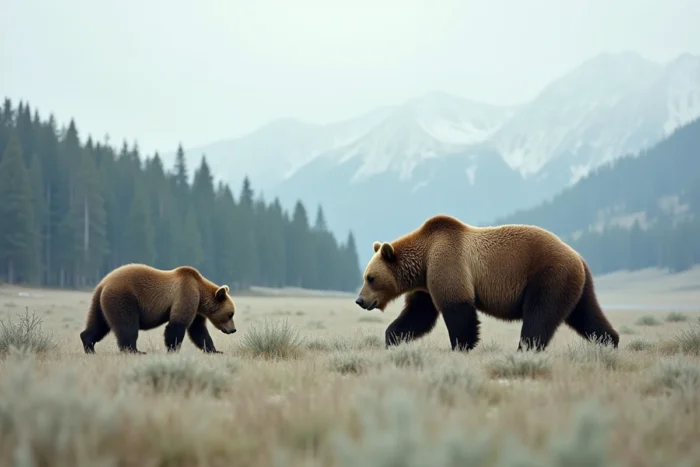
Ecological Factors That Determine Size in Ursus arctos
Three variables explain most of the size differences within the species, regardless of subspecies:
- Access to salmonids: Coastal populations (Alaska, Kamchatka) that intercept salmon runs accumulate lipid reserves far exceeding those of continental populations. This surplus directly translates into body mass before hibernation.
- Duration and severity of hibernation: a bear that hibernates longer loses more mass. Pyrenean bears, despite relatively mild winters, have limited autumn resources compared to their Scandinavian or Carpathian counterparts.
- Population density and intraspecific competition: in the Romanian Carpathians, high density pushes some individuals towards anthropogenic food sources (orchards, dumps), which can artificially inflate the average size.
The Bergmann’s rule, often invoked (individuals are larger in cold latitudes), only partially applies to the brown bear. Diet takes precedence over latitude.
Grizzly vs. European Brown Bear: Verdict on Size
The average North American grizzly exceeds the average European brown bear, whether Pyrenean or Scandinavian, in mass and stature. On this point, the answer is clear. The coastal grizzly from Alaska dominates all western European populations.
The nuance lies in the margins of the Eurasian range. Brown bears from Kamchatka and Ussuri reach sizes comparable to the largest North American specimens. Reducing the Eurasian brown bear to its western European component is like comparing the smallest population of the Old Continent to the largest terrestrial predator in North America.
The size of a brown bear primarily tells its ecology, not its passport. A coastal grizzly stuffed with sockeye salmon and a Kamchatka bear stuffed with keta salmon look much more alike than an interior grizzly and a Kodiak separated by a few hundred kilometers.