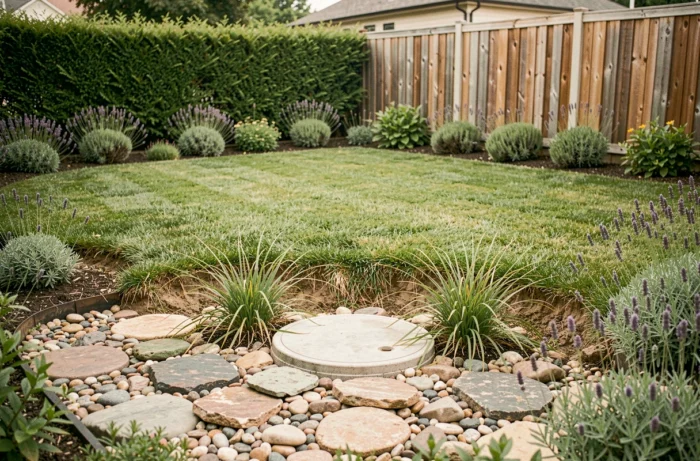
A septic tank (or all-water tank) collects all domestic wastewater, separates solid materials from the liquid, and then transfers the effluent to a treatment system: drainage trenches, sand filter, or compact filter. Any development located near this system must meet two technical requirements: not compromise the purification process and maintain free access for maintenance and inspections by the SPANC.
Technical constraints imposed by the soil before any development
Before designing any landscaping or laying a surface, the nature of the ground dictates what is possible. Almost all SPANCs now require a soil and system study before the design or standardization of an installation. This study determines the location of the trenches, the length of the drains, the slope of the land, and the actual surface available for a landscaping project.
Clay soil, for example, retains water and limits the useful depth for drainage. Sandy soil drains quickly but poorly tolerates surface overload. Knowing these parameters prevents placing a heavy installation directly over a critical area.
When considering the landscaping around a septic tank, the first step is to obtain the installation plan (available from the SPANC or the design office that created the system) and to precisely locate the footprint of the tank, inspection chambers, and drainage fields.
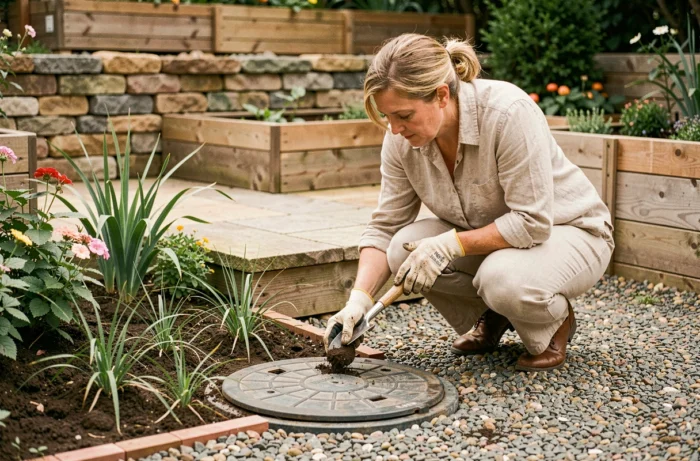
Prohibited surfaces and structures above the sanitation system
Some common developments are explicitly discouraged or even prohibited above the system. This point is rarely detailed in content focused on aesthetic camouflage, even though it conditions all the thinking.
- Masonry terrace or concrete slab: it waterproofs the ground, blocks the evapotranspiration necessary for the proper functioning of the drainage, and prevents access to the inspection chambers for emptying or inspection.
- Driveway or vehicle parking: repeated weight can crush the drains or deform the tank, especially on polyethylene tanks.
- Heavy garden shed, playground with foundations, or any structure requiring deep anchoring: the foundations risk puncturing the pipes or altering the load distribution on the tank.
- Planting deep-rooted trees (willow, poplar, running bamboo): the roots penetrate the joints of the pipes and clog the drains within a few years.
The basic rule can be summed up in one sentence: nothing heavy, nothing impermeable, nothing deeply rooted above the drainage area and the tank.
Plants compatible with a septic tank: selection criteria
Suitable plants share a common trait: a shallow root system that remains in the top few centimeters of soil. Ornamental grasses, ground-cover perennials, and small shrubs with fibrous roots meet this criterion.
Grass remains the safest cover. It stabilizes the soil, promotes evapotranspiration, and can be easily removed during an intervention on the system. A low flowering meadow produces the same effect while eliminating the need for regular mowing.
Perennials with shallow roots (sedums, creeping thymes, yarrow) provide an aesthetic alternative to dress the surroundings without risking damage to the drains. Their low water requirement also limits inputs that could saturate the soil above the drainage.
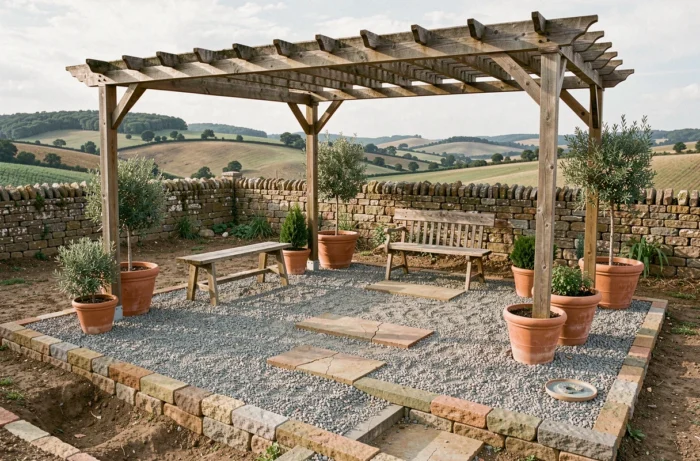
Safety distances for shrubs
A compact shrub (lavender, spiraea, potentilla) can be planted around the drainage area, provided that a sufficient distance from the trenches is maintained. The installation plan provided by the SPANC allows for checking this margin. In case of doubt, moving the planting back a few more meters remains the simplest precaution.
Concealing inspection chambers and vents without blocking access
The inspection chamber covers and ventilation vents are the most visible elements of a septic installation. Concealing them without making them inaccessible requires a removable arrangement.
A removable decorative cover (fake resin rock, wooden box not fixed to the ground, planter on legs) serves this function. The determining criterion: it must be possible to move it alone, in less than a minute, to allow the technician to pass during an emptying or SPANC inspection.
Potted plants placed around the inspection chambers offer a flexible solution. Unlike a mass planted in the ground, they can be moved effortlessly and do not generate any roots under the cover. A few tall grasses in pots are enough to create an effective visual screen.
Vents: never obstruct the ventilation
The vent ensures air circulation in the tank and the evacuation of fermentation gases. Blocking a vent causes odors to rise into the home and disrupts the bacterial process. Any camouflage solution must leave sufficient air clearance around the tube. A trellis planted with light climbers (clematis, star jasmine) at a distance from the vent can visually mask the tube without blocking the airflow.
Light and removable coverings for movement around the tank
To create a pathway or a small relaxation area near the tank, permeable and removable coverings are the only ones compatible with the sanitation system.
- Wooden decking laid on a gravel bed: permeable, lightweight, removable in a few minutes for intervention.
- Stepping stones spaced on grass or gravel: they do not create a continuous impermeable surface.
- Stabilized gravel or mineral mulch: it allows water to infiltrate and exerts no load on the drains.
A wooden deck on joists (without concrete foundation) can cover a small area adjacent to the tank, provided that the inspection chambers remain accessible through an integrated hatch or removable panel. This type of lightweight terrace must never rest directly on the drainage area.
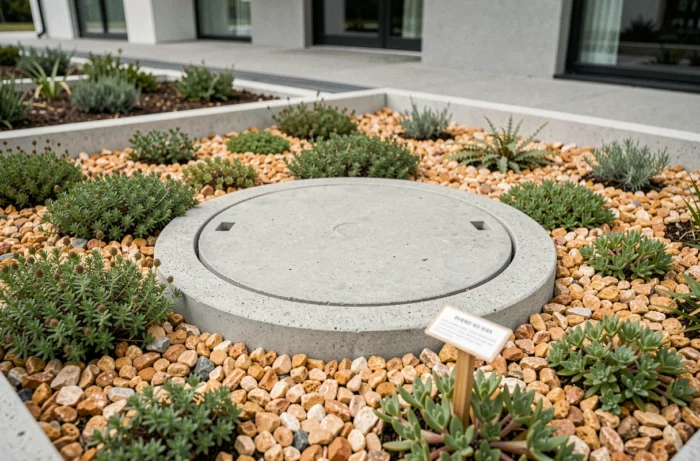
The choice of landscaping around a septic tank is based on a constant principle: everything that is placed must be removable, and everything that grows must remain on the surface. Keeping the installation plan handy during every gardening project is enough to avoid most costly mistakes.