
The anal fistula is an infectious tract that connects a gland in the anal canal to the perineal skin. Unlike an anal fissure (a simple superficial tear), the fistula forms a persistent tunnel, often fed by an underlying abscess. When the question of non-surgical treatment arises, the available online responses mix comfort care, traditional approaches, and genuine therapeutic avenues. The current state of medical knowledge requires untangling these registers.
Anal Fistula and the Limits of Local Care: What Recent Literature Confirms
Recent publications on perineal fistulizing disease remind us of a point often absent from mainstream articles: an anal fistula does not heal spontaneously in the majority of cases. The fistulous tract is lined with granulation tissue that prevents natural closure, and the persistence of an infectious focus maintains the drainage.
Recommended read : Discover the best beauty tips to enhance your daily routine
In the presence of an associated abscess or a complex fistula (multiple branches, involvement of the sphincter), simple waiting or local care can worsen the diagnostic delay. Current recommendations emphasize the need for imaging (perineal MRI) and specialized management before any conservative strategy.
Exploring natural treatments for anal fistula remains legitimate for simple, low fistulas without active abscess. The nuance lies in the type of fistula and the timing of management.
See also : How to Choose the Best Reliable Download Directories in 2024?

Documented Conservative Care for Simple Anal Fistula
The term “natural treatment” encompasses very different practices. Some pertain to symptomatic comfort, while others belong to a codified medical tradition. Here are the most frequently mentioned approaches, along with their known limitations.
Sitz Baths and Perineal Hygiene
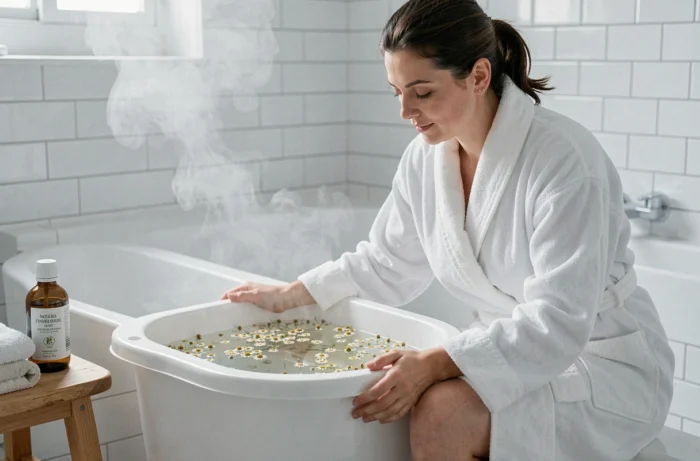
Sitz baths in warm water remain the basic measure to reduce pain and keep the anal area clean. They promote relaxation of the sphincter and limit maceration around the external opening of the fistula. No data shows that they accelerate the closure of the tract, but they decrease discomfort between drainage episodes.
High-Fiber Diet and Hydration
Constipation worsens any anal pathology by increasing pressure on the canal. Adequate intake of fiber and water softens stools, reduces straining, and limits mechanical irritation of the fistulous area.
- Soluble fibers (psyllium, oats, legumes) regulate transit without causing excessive bloating if the increase is gradual
- Regular hydration, spread throughout the day, complements the effect of fiber on stool consistency
- Irritating foods (spicy foods, alcohol) can intensify local pain and are generally discouraged during inflammatory phases
Oils and Topical Applications
Some vegetable oils (coconut oil, castor oil) are used topically for their emollient properties. Tea tree oil is sometimes mentioned for its antiseptic activity. No published clinical trial validates these applications on an anal fistula. They may soothe the perianal skin, but do not close a fistulous tract.
Ksharasutra Technique: An Ayurvedic Approach Between Nature and Medical Procedure
Among the most documented non-surgical approaches is the Ksharasutra, derived from Ayurvedic medicine. This technique involves placing a medicated thread (coated with alkaline herbs and latex) in the fistulous tract. The thread causes slow chemical cauterization that gradually destroys the pathological tissue and allows the tract to close through directed healing.
The Ksharasutra is sometimes presented as a “non-surgical” alternative. In reality, the procedure requires a trained practitioner and prior drainage of the tract. It is a minimally invasive procedure, not a home remedy. Field reports differ on recurrence rates compared to classic fistulotomy, and the technique remains little practiced in France.
Cellular Therapy and Crohn’s Anal Fistula: The Most Recent Avenue
The “non-surgical” treatment that has the most recent data is neither a sitz bath nor a vegetable oil, but local cellular therapy. Studies report positive results with the injection of mesenchymal stem cells directly into the fistulous tract, particularly in patients with Crohn’s disease with refractory perineal fistula.
These cells act through immunomodulation and stimulation of tissue healing. Cellular derivatives (exosomes) are also under study. This approach targets complex fistulas resistant to biologics and drainage, not simple fistulas for which conventional surgery remains the standard treatment.
The available data do not yet allow for generalizing this technique to all anal fistulas. Access remains limited to specialized centers, and the cost is not covered by most European reimbursement systems.
Seton Drainage: The Conservative Control Strategy
The non-cutting seton is a flexible thread placed in the fistulous tract to maintain permanent drainage and prevent the reformation of an abscess. It is not a definitive treatment, but a step in controlling the infection that prepares for a subsequent procedure (fistulotomy, advancement flap, stem cell injection).
Recent literature emphasizes this strategy as an essential prerequisite before any conservative or minimally invasive approach. The seton keeps the tract open, which seems paradoxical, but precisely prevents the accumulation of pus and degradation of the sphincter.
- The seton is placed under local or general anesthesia, depending on the depth of the tract
- It remains in place for several weeks to several months, depending on clinical evolution
- Premature removal exposes to recurrence of the abscess and reformation of the tract
The anal fistula remains a condition where the involvement of a specialized proctologist determines the outcome, regardless of the type of treatment considered. Comfort care (sitz baths, appropriate diet, rigorous hygiene) usefully accompanies management but does not replace it. Any persistent anal pain or recurrent drainage justifies imaging and medical advice before considering a conservative strategy.